
Archived from the original dev blog and left as it was written, so it reflects the game as it stood in 2008.
Hey guys! My name is Frank, texture artist for Black Mesa. In this short blog I will discuss the process of prop creation and how level designers, 3D modellers and texture artists work together to turn a game level into an actual world.
Detailing the environment is one of the more important aspects in level design. It creates a plausible environment, assuring players to be immersed into Black Mesa.
Details can be all kind of things, from generic junk (like coffee mugs, trash cans, crates, power boxes etc.) to more specific models, such as structural supports, oddly shaped railings or the AMS found in the Anomalous Materials lab test chamber.
Items from the first group are usually created by our 3d and 2d artist without much collaboration between them and level designers. Once created, the models are uploaded to our build, allowing level designers to choose from a large amount of generic props to detail their worlds.
The second group asks for much more collaboration between level designers and prop artists. Models need to fit in with their surrounding geometry, and textures need to blend in perfectly with the art style of the level.
To explain this I'll show you an example of the opening level of Blast Pit, which is being created by Chris 'Stormseeker' Horn.
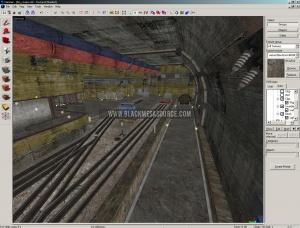
Because of the odd shape (a huge train tunnel going in a semi-circle, I'm sure you remember it ), a lot of new props had to be created from scratch to fit the circular design. Stormseeker designed the level and created ALL detailing with brushwork in Hammer. He out so much detailing it, the maximum number of solids was exceeded and he was unable to compile his map. Here's a hammer-shot of the start of the tunnel, the train platform area:
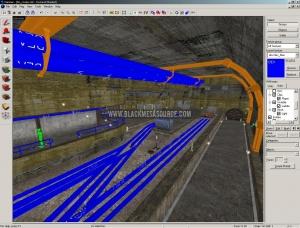
To bring down the number of solids while remaining the level of detail , complex brushwork needs to be converted to models. In this case it's pretty obvious where all the detail went: the tunnel supports, the pipes, the tracks and the railings.
To convert them, all objects are exported to DFX, a format that can be loaded in a 3D program.
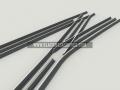
The objects are then recreated by the modeller (in this case, me) using the DFX as a guide. Finally it is textured to fit the style of the rest of the map. Here's a couple of renders of the props made for this part of the map:
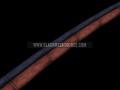
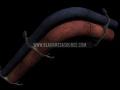
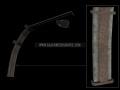
Once compiled and committed to our build, they can be placed in game. As you can see, they fit perfectly.
One of the drawbacks of this technique is the sheer amount of level-specific props being made for Black Mesa. So far we have made over 650 (that's right, six hundred and fifty) unique, finalised props! This does not include cumulative props such as gib parts for crates/machines/mugs/etc. This builds up to a fairly large installation file that all of you need to download when release time comes. However, I think we can all agree it's worth it 😉.
I would've liked to show you some in game shots of this particular area, but unfortunately the map can not be compiled yet, a lot of converting still needs to be done in this map. But I'm sure Stormseeker will show you something when the moment is right 😉.
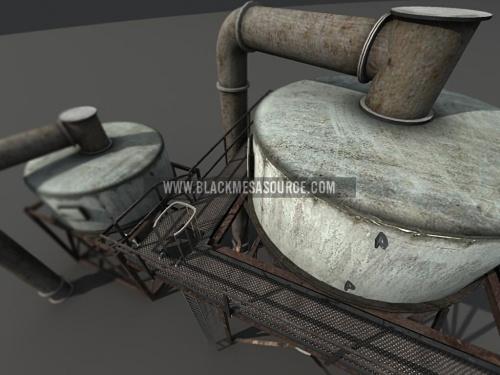
As a bonus, here's a sweet picture of a prop for Residue Processing. This was featured earlier in a blog by Carlos, but it only showed a small 150x150 pixels image. Enjoy the highres picture.
Well, that's it for today! The blog turned out to be quite a bit bigger than I had planned, but I'm sure none of you mind. I hope next time you see one of our level shots you think of all the 2D/3D artists involved in the design process, not only the lead level designer. We feel underappreciated.